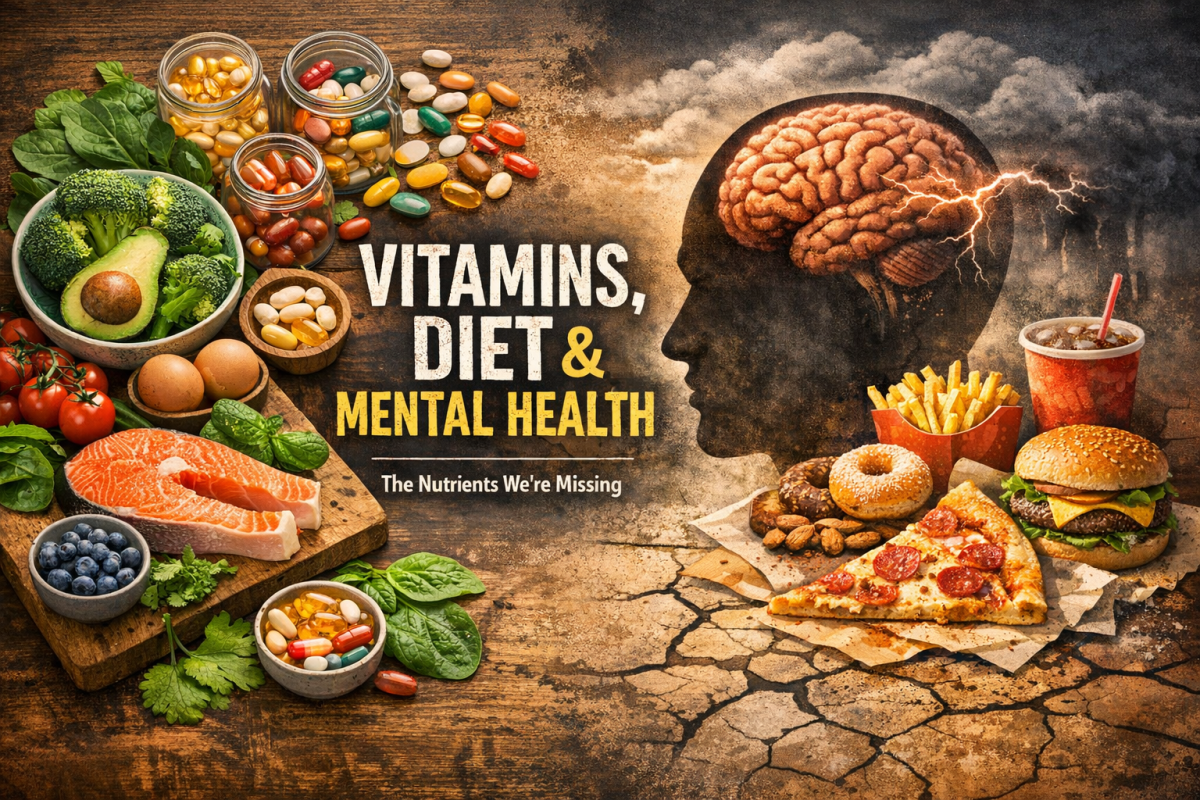
Walk into any grocery store in America and you’ll see the same paradox: aisles overflowing with food, yet a population quietly starving for nutrients that actually support the brain, mood, and long‑term health. It’s one of the great contradictions of the modern American diet — abundance without nourishment.
We talk a lot about calories. We talk a lot about protein. But we rarely talk about the vitamins that keep our minds stable, our energy consistent, and our emotional resilience intact. And in a country where convenience foods dominate and stress levels are sky‑high, that gap is starting to show.
The Vitamin Deficit Hidden in Plain Sight
Despite living in one of the wealthiest food environments in the world, Americans are chronically low in several key vitamins tied directly to mental health:
- Vitamin D — essential for mood regulation
- B vitamins — crucial for energy, focus, and nervous system stability
- Omega‑3s — foundational for brain health and emotional balance
- Magnesium — supports sleep, stress response, and muscle relaxation
These aren’t fringe nutrients. They’re the biochemical backbone of feeling human.
Yet the Standard American Diet (SAD) — heavy on processed grains, added sugars, and industrial oils — leaves millions undernourished in ways that don’t show up until the symptoms do: irritability, fatigue, brain fog, anxiety spikes, and emotional volatility.
If you want a deeper dive into how food culture shapes our emotional lives, you might enjoy our earlier piece on how the American Dream slipped off the dinner table .
The Food–Mood Connection Isn’t Woo — It’s Biochemistry
Mental health isn’t just psychological. It’s nutritional.
Your brain is a nutrient‑hungry organ, and when it doesn’t get what it needs, it sends signals — sometimes subtle, sometimes loud.
- Low B12 can mimic depression.
- Low magnesium can heighten anxiety.
- Low vitamin D can flatten mood and motivation.
- Low omega‑3s can impair emotional regulation.
This is why so many clinicians now consider nutritional status a foundational part of mental health care. It’s not a replacement for therapy or medication — it’s the soil those interventions grow in.
If you want to explore how vitamins fit into a holistic care model, HIAAH has a helpful overview of their approach here: Vitamin Services at HIAAH .
Why the American Diet Makes This Harder Than It Should Be
The modern food system is optimized for:
- Shelf life
- Speed
- Cost
- Convenience
It is not optimized for micronutrient density.
Fresh produce is expensive. Cooking takes time. Ultra‑processed foods are engineered to be irresistible. And the result is a population that is technically fed but nutritionally fragile.
This fragility shows up in our mental health statistics long before it shows up in our lab work.
Reclaiming Nutritional Sanity, One Habit at a Time
You don’t need a perfect diet to support your mental health — you just need a more intentional one.
A few high‑impact shifts:
- Add one leafy green to your daily routine.
- Swap one processed snack for a whole‑food option.
- Prioritize foods rich in omega‑3s (salmon, walnuts, flax).
- Consider a vitamin D supplement if you live in a low‑sun region.
- Build meals around color, not convenience.
For more on building intentional food rituals, check out our guide to creating a kitchen routine that actually supports your life .
Small changes compound. And when the goal is mental clarity, emotional steadiness, and long‑term resilience, those changes matter more than we’ve been taught to believe.

 The Red Alert Blog
One reply on “When Vitamins Become a Lifeline: What the American Diet Isn’t Giving Us (And What That Means for Mental Health)”
Informative post
LikeLike