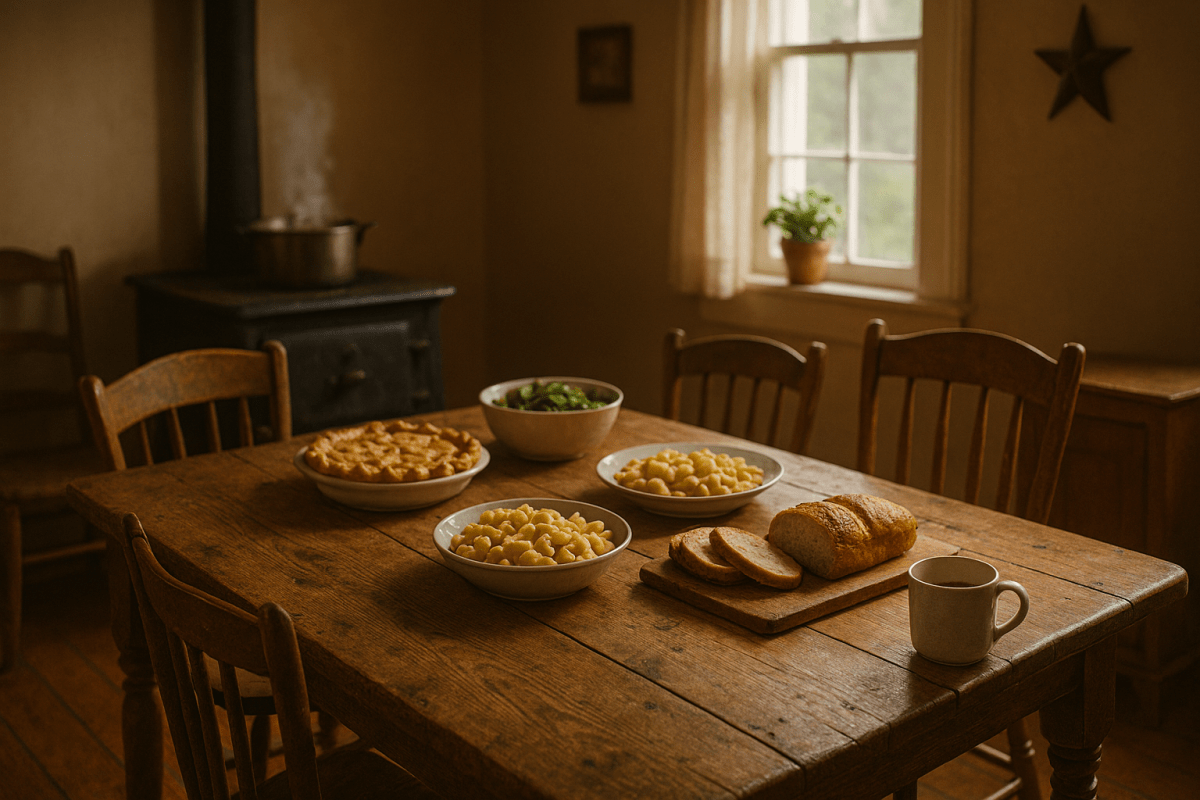
Food lovers understand something most people overlook:
If you want to know how a nation is doing, look at its dinner table.
Food is the first place where economic pressure shows up.
It’s the first place where culture evolves.
It’s the first place where families feel the squeeze — or the relief.
And right now, the American table is telling a story we can’t afford to ignore.
This isn’t nostalgia.
This is a wake‑up call.
Because the American Dream used to be something you could taste.
Now it’s something many people can barely afford to smell.
🍳 When the American Dream Was Served Hot
Ask anyone who grew up in the 60s or 70s what the American Dream looked like, and they won’t describe a mansion or a yacht. They’ll describe a kitchen.
A small home.
A family table.
A pot of something simmering.
A sense of stability you could feel in the air.
Food was the heartbeat of the Dream.
Sunday dinners.
Holiday spreads.
Neighborhood cookouts.
Recipes passed down like treasure.
And here’s the part that matters:
In 1970, the average American could realistically secure the seven pillars of the American Dream — a home, a family, education, healthcare, transportation, retirement security, and upward mobility — in about 30,000 hours of work.
That’s roughly 15 years of full‑time effort.
Fifteen years to build a life.
Fifteen years to create a home where food wasn’t a luxury — it was a ritual.
🥘 Food Culture Exploded — But So Did the Cost of Living
Fast‑forward to today.
We live in a golden age of flavor.
Global ingredients.
Fusion cuisine.
Farm‑to‑table everything.
Food shows, food influencers, food tourism, food obsessions.
Our plates got more exciting.
Our grocery bills got more painful.
Because while food culture expanded, the American Dream shrank.
By 2025, the time cost of achieving that same seven‑pillar Dream skyrocketed to 103,800 hours — nearly 52 years of full‑time work.
Let that sink in.
The Dream that once took 15 years now takes almost an entire working lifetime.
And food lovers feel this shift first.
🍲 Food People Notice the Cracks Before Anyone Else
If you love food, you pay attention.
You notice when a dozen eggs jumps from $1.29 to $6.49.
You notice when a simple grocery run feels like a luxury outing.
You notice when restaurants quietly raise prices, shrink portions, or cut corners.
You notice when:
- A family dinner becomes a budgeting exercise
- A holiday feast becomes a financial stretch
- A night out becomes a rare indulgence
- A home‑cooked meal becomes the only viable option
Food is the canary in the coal mine of the American Dream.
And right now, that canary is wheezing.
🍕 The Dream Used to Arrive in Your 30s — Now It Shows Up in Your 60s
In 1970, you could expect to:
- Buy a home
- Raise a family
- Build a life
- And still have time to enjoy it
By your mid‑30s.
Today?
The Dream doesn’t arrive in your 30s.
Or your 40s.
Or even your 50s.
For many Americans, it arrives — if at all — in their late 60s.
That’s not a dream.
That’s a delay.
And it changes everything about how we eat, gather, celebrate, and live.
🥗 But Food Is Still Where Hope Lives
Here’s the twist:
Food lovers are some of the most resilient people on the planet.
We adapt.
We create.
We stretch ingredients.
We reinvent traditions.
We turn scarcity into creativity.
Food people know how to make something out of nothing.
We know how to turn a cheap cut into a masterpiece.
We know how to turn a small kitchen into a sanctuary.
We know how to turn a shared meal into a moment of abundance.
Food is still the most democratic joy we have left.
It’s still the place where connection happens.
It’s still the place where the Dream feels alive — even when everything else feels out of reach.
🍽️ The New American Dream Starts With a Table, Not a Mortgage
Maybe the American Dream isn’t dead.
Maybe it’s evolving.
Maybe it’s becoming less about owning things and more about experiencing things.
Less about square footage and more about connection.
Less about climbing and more about savoring.
Food lovers are leading that shift.
Because when you cook for someone, you’re saying:
- You matter
- You belong
- You’re welcome
- We’re in this together
And that’s the heart of the American Dream — not the house, not the car, not the paycheck, but the table.
A place where people gather.
A place where stories are shared.
A place where life slows down.
A place where the Dream still feels possible.
🍰 If You Love Food, You’re Already Rebuilding the Dream
Food lovers are the memory‑keepers.
The culture‑carriers.
The community‑builders.
The ones who remind the world that joy doesn’t have to be expensive.
You don’t need a 3,000‑square‑foot house to make a great meal.
You don’t need a six‑figure income to create a moment of magic.
You don’t need the old American Dream to live a meaningful life.
You just need a kitchen.
A table.
A recipe.
A story.
A willingness to share.
Food is how we reclaim the Dream — not by chasing what used to be, but by creating what comes next.

 The Red Alert Blog